Instrumentation
Revolutionizing Vacuum Bake-Out Systems with DMX512
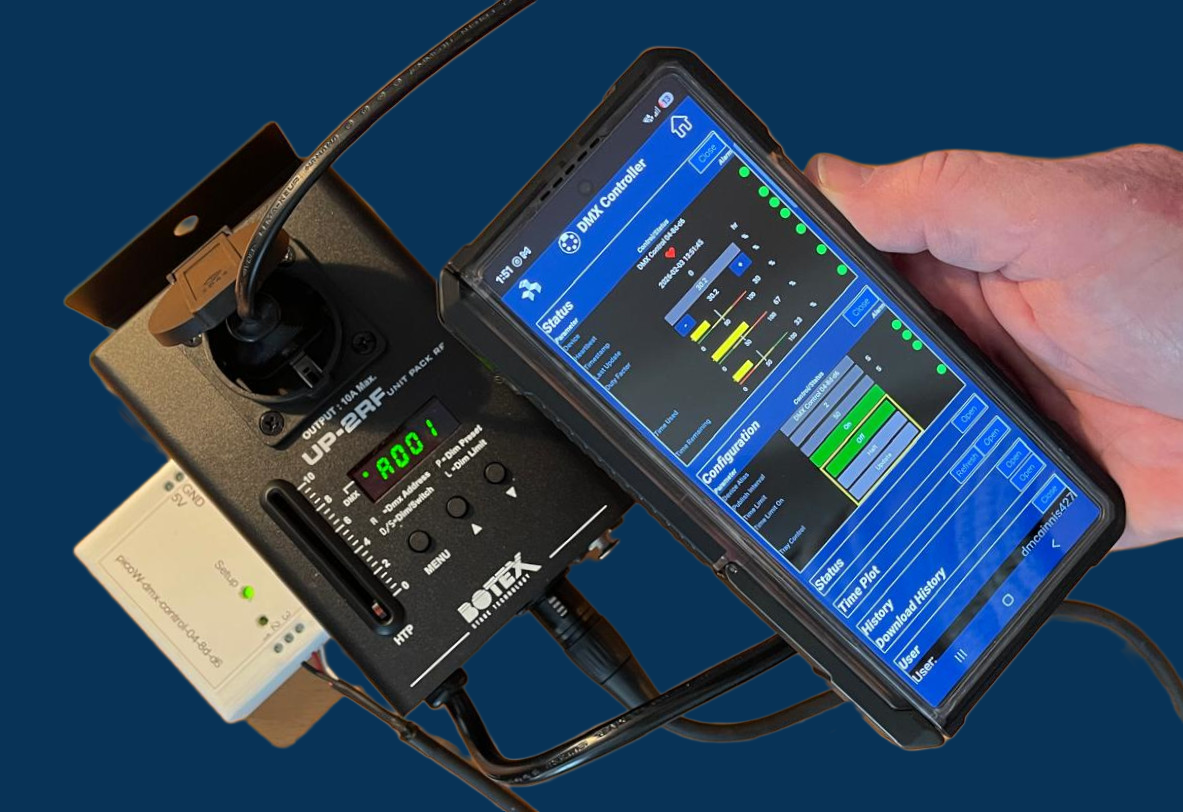
Building a remotely accessible ultra-high vacuum bake-out system presents a unique engineering challenge: managing significant power safely and affordably. Typically, these systems rely on 800W to 2kW heating tapes. While we always utilize CE-marked, commercially available power converters for safety, we realized that using standard DC supplies for heat production was unnecessarily complex and expensive for simple resistive heating.
The Lighting Breakthrough: High Power, Low Cost
We discovered an elegant solution in an unexpected place: the theater. Channel dimmers used for theatrical lighting match our power requirements perfectly and are significantly more cost-effective than traditional DC power converters.
By adopting DMX512—the industry standard for stage lighting—we gained a robust framework for control. Under the hood, DMX512 is essentially RS-485. To bridge this to our system, we built a custom interface using a Raspberry Pi PicoW and an SN75176A Differential Bus Transceiver chip.
Under the Hood: Raspberry Pi PicoW & PIO
The Raspberry Pi PicoW is our “workhorse” for interfacing with our Blinky-Lite control system. Its architecture provides two major technical advantages for industrial control:
- Dual-Core Efficiency: We dedicate one core entirely to Blinky-Lite communications and the second core to the custom logic for the specific device. This ensures that a heavy communication load never delays critical hardware control.
- The PIO Advantage: The PicoW features eight Programmable I/O (PIO) state machines. We use one of these to manage the DMX512 signal generation. Because the PIO handles the timing-critical bit-banging hardware-side, it doesn’t tax the main processor cores at all.
- Massive Scalability: While we currently only need to control a one-device “universe,” a single PIO state machine can handle 512 devices. With the PicoW’s eight PIO machines, this tiny controller theoretically has the power to manage 4,096 DMX devices.
Reliability in the Wireless World
When we tell people we use wireless communications for industrial vacuum systems, the first question is always: “Is it reliable?”
The answer is a definitive yes. When implemented with the right redundancies, wireless can be more reliable than a physical cable plant subject to wear and interference. Our “triple-layered strategy” for rock-solid communication includes:
- MQTT Protocol: A robust, industry-standard messaging protocol for IoT.
- Watchdog Counters: Every device monitors both upload and download counters to instantly flag missing packets.
- Fail-Safe Actions: The system is programmed to take immediate “safe-state” actions (such as shutting down heaters) the moment a communication lapse is detected.
Beyond the Lab
While we built this for ultra-high vacuum systems, the applications are endless. This controller is equally at home managing wireless theatrical lighting or any high-power industrial application where cabling is a liability.
By thinking outside the box—and inside the theater—we’ve created a system that is safer, cheaper, and more scalable. Best of all? No more cables to trip over.
david-mcginnis
CUBES
post instrumentation